Reusable Object Navigation

SSTG-Nav: Metric-Grounded Spatial-Semantic Topological Graphs for Reusable Object Navigation

Pre-explore once. Ground objects metrically. Navigate repeatedly.

1 The Hong Kong University of Science and Technology (Guangzhou)  ·  2 Shandong University  ·  Corresponding author

Explore the project

The central idea

Turn one survey into a reusable navigation memory.

Object recognition alone does not tell a robot where it can safely stop. SSTG-Nav bridges that gap by attaching semantic evidence to metric, reachable standoffs and preserving them for future requests.

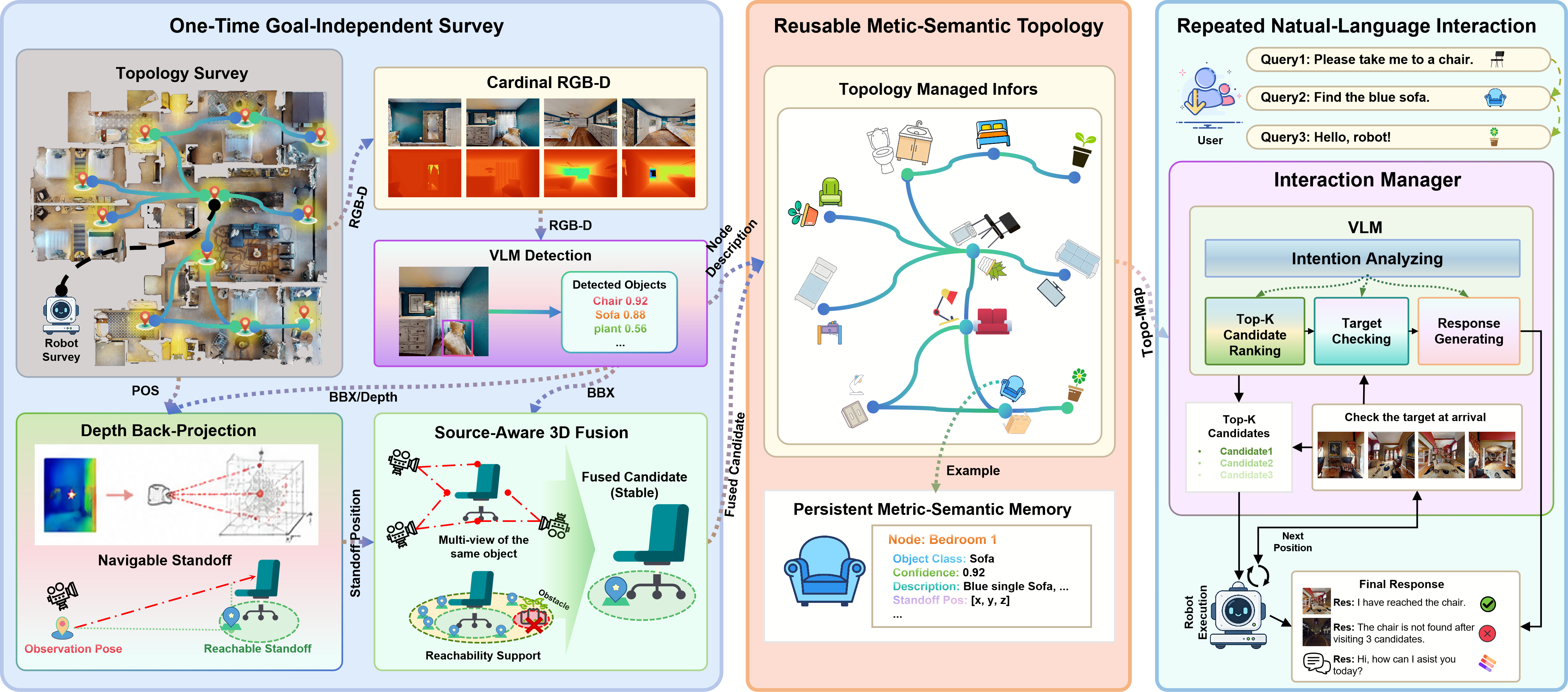
SSTG-Nav pipeline from a one-time goal-independent survey through reusable metric-semantic topology to repeated natural-language navigation
System overview. A one-time RGB-D survey builds a persistent spatial-semantic topology; repeated language requests retrieve reachable candidates, execute navigation, and verify arrival.

Abstract

Service robots operating for months in the same homes, offices, and facilities should become more reliable with experience instead of searching familiar space from scratch for every request. Yet ObjectNav is predominantly formulated as one-shot exploration, leaving a central deployment challenge unresolved: recognizing an object does not identify a reachable place to stop, and one confident map error can terminate the task.

We introduce SSTG-Nav, a reusable metric-semantic memory that turns a one-time survey into actionable object goals, consolidates evidence across viewpoints, and retains spatially distinct recovery standoffs. Across 1,000 HM3D-v2 episodes and a ROS 2/Nav2 realization, the results establish pre-exploration as a practical regime for dependable, repeated semantic navigation.
01

Goal-independent survey

Build the topology before any ObjectNav goal is revealed.

02

Actionable semantics

Back-project RGB-D evidence into reachable, object-centric standoffs.

03

Recovery by design

Keep distinct alternatives, verify arrival, and continue when a candidate fails.

Method

From pixels to places the robot can reach.

Each detection is geometrically grounded, consolidated across observations, and stored alongside the navigation graph—so a later language query resolves to a physical standoff rather than a camera pose.

1

Survey

Farthest-point exploration samples free space and captures calibrated cardinal RGB-D views.

2

Ground

Depth back-projection converts semantic detections into metric object locations and reachable standoffs.

3

Fuse

Source-aware 3D and reachability checks merge corroborating views without erasing useful alternatives.

4

Retrieve & recover

Language retrieval ranks candidates; fresh arrival evidence decides whether to stop or continue.

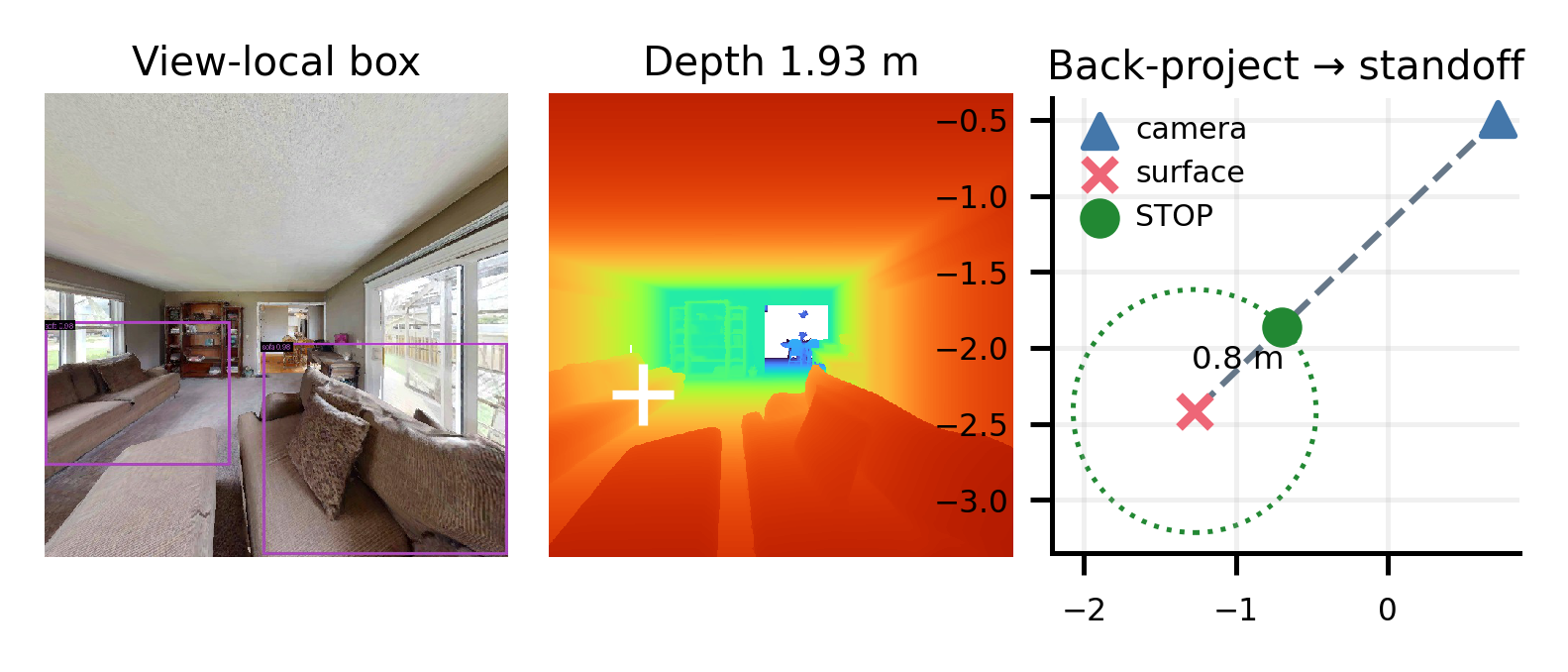
RGB-D grounding from visual detection through depth back-projection to a reachable object-centric standoff
Metric grounding. A visual observation becomes an actionable goal while free-space constraints keep the proposed standoff reachable.
Persistent memoryReusable
6,642
topology nodes
21,845
navigable edges
1,329
fused candidates

One representation supports multiple object requests without rebuilding the map or revisiting the whole environment.

Full validation

Metric grounding closes most of the gap to geometric coverage.

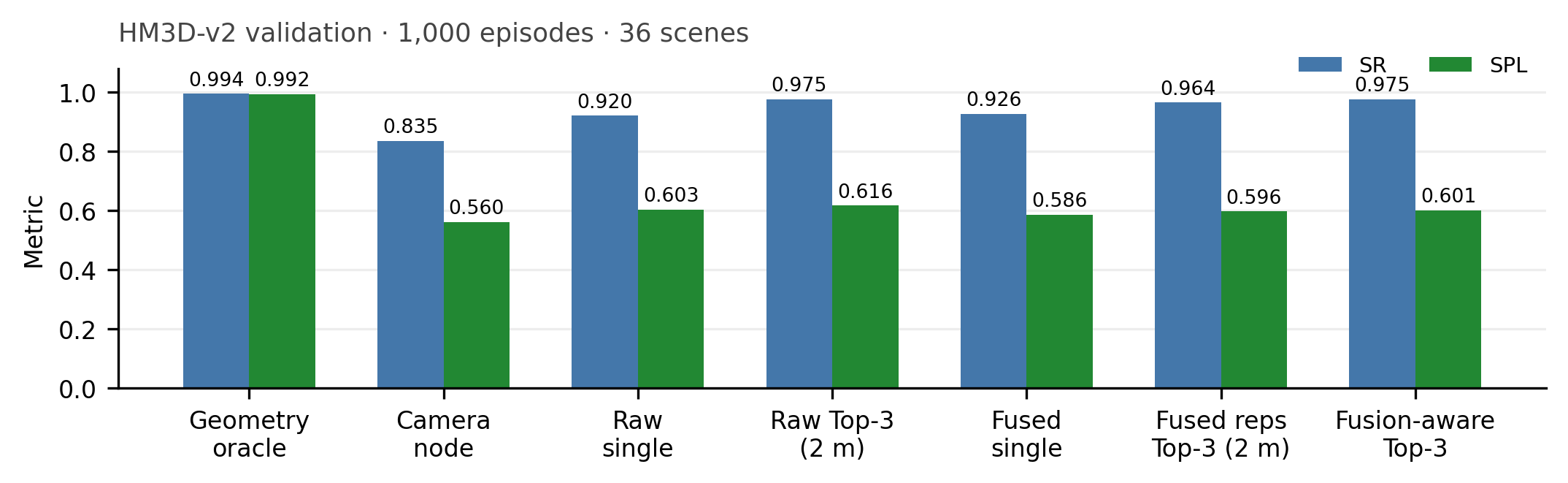
Results use 1,000 episodes across all 36 HM3D ObjectNav-v2 validation scenes. All system variants share the same goal-independent topology protocol.

Camera node 83.5% SR · 0.560 SPL
Metric grounded 92.0% SR · 0.603 SPL
Fusion-aware Top-3 97.5% SR · 0.601 SPL
Bar chart comparing success rate and SPL for geometry oracle, camera-node, raw metric, fused, and Top-3 SSTG-Nav variants
Independent full-validation results. Metric grounding produces the largest single-step gain; structured recovery reaches 97.5% success while retaining competitive path efficiency.
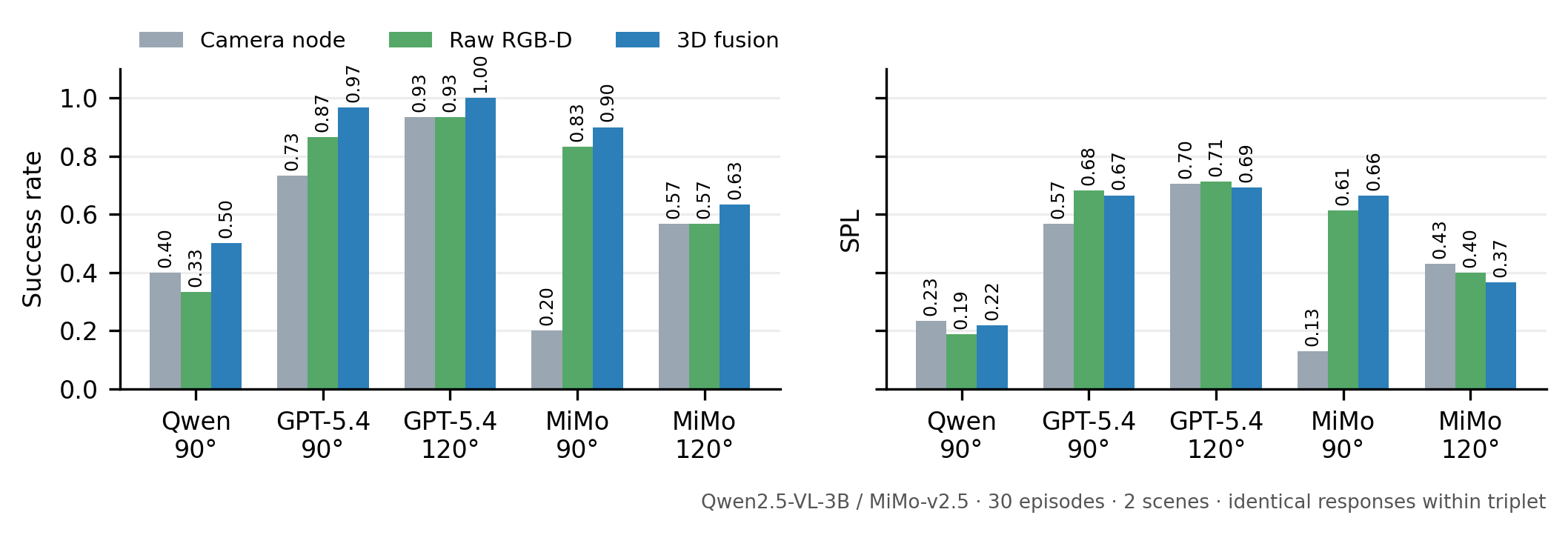
Metric ablation results for grounding, fusion, and recovery components
Controlled ablations. Grounding, consolidation, and recovery make distinct contributions.
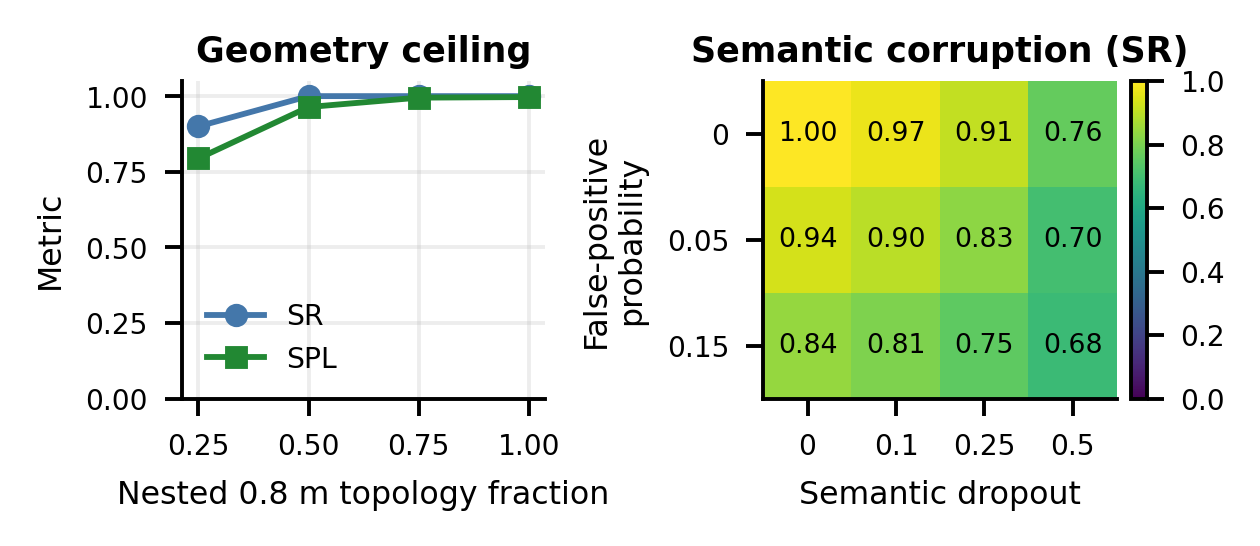
Topology density, semantic model, and corruption control results
Stress tests. Density, semantic model, and corruption controls reveal where performance originates.

What the topology preserves

Compact enough to reuse. Diverse enough to recover.

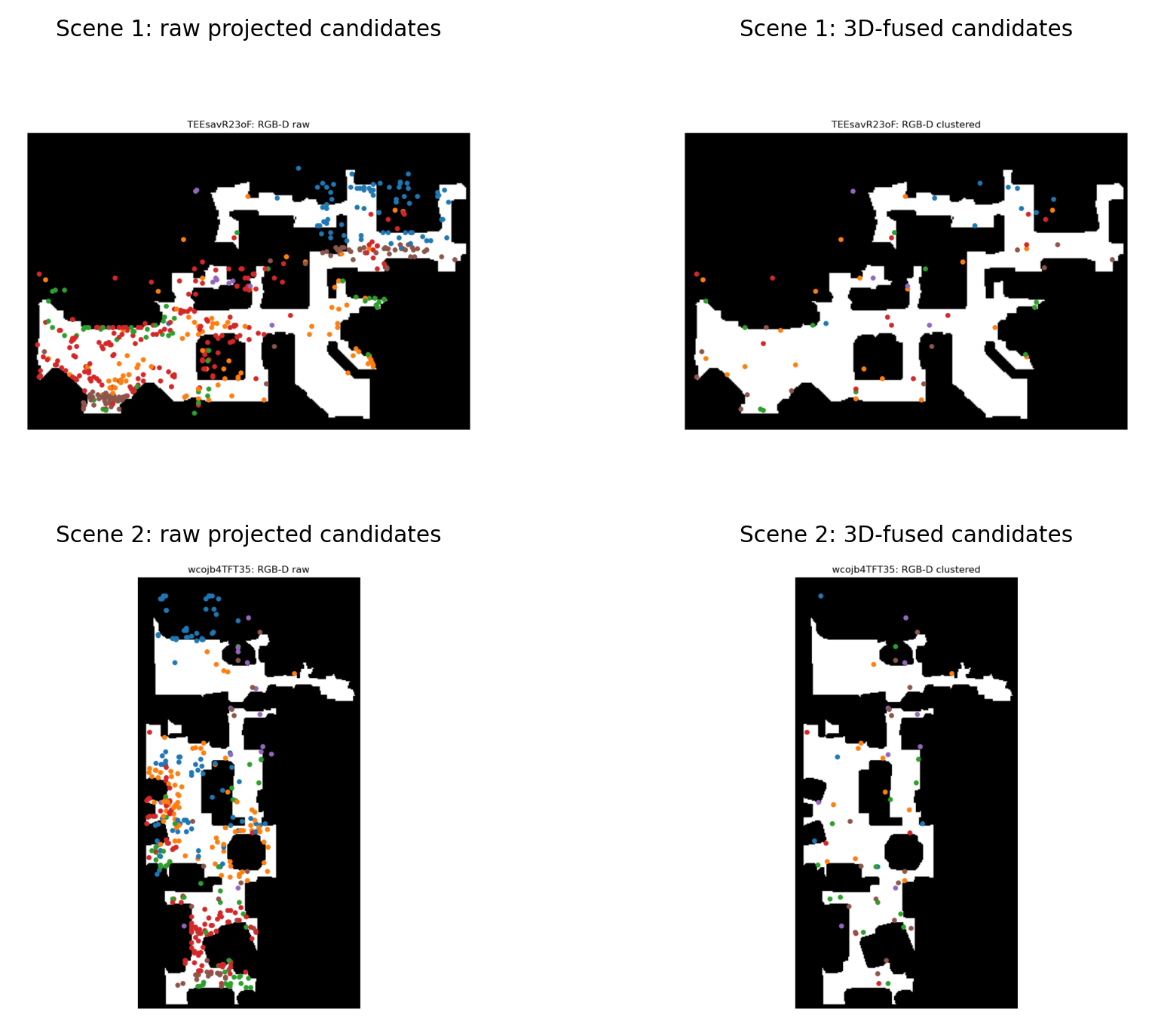
Source-aware fusion reduces 20,107 raw candidates to 1,329 fused candidates—a 93.4% reduction—while residual metric standoffs retain spatial diversity for sequential recovery.

Example SSTG-Nav topological maps showing spatial sampling and semantic candidates
Goal-independent topologies. Spatial coverage is constructed without access to downstream ObjectNav goals.
93.4%candidate reduction through source-aware fusion

Why not merge everything?

A fused representative is valuable when independent views corroborate the same physical object. But over-fusion can remove the spatially distinct options needed after a blocked approach or false-positive arrival.

Fusion-aware Top-3 therefore begins with the strongest supported representative, then draws recovery options from residual metric standoffs.

Benchmark trajectories

See why the destination representation matters.

These short Habitat trajectories come directly from the public benchmark outputs. The paired sofa case holds the scene and target category fixed, isolating the effect of a supported fused destination.

Same sceneSame sofa queryDifferent destination representation
Failure
A

Raw single candidate

An unsupported local hypothesis sends the agent to the wrong sofa instance.

Success
B

Source-aware fused goal

Multi-view support selects a stable metric standoff and reaches the correct sofa.

Additional episodes

Successful navigation across object categories

First-person views from the released HM3D evaluation artifacts.

Success
ChairHM3D full validation · 7.4 s
Success
BedHM3D full validation · 3.3 s
Success
ToiletWide-FoV RGB-D audit · 3.8 s

Physical deployment

The same memory closes the loop on a real robot.

A ROS 2/Nav2 realization connects live RGB-D observations, semantic retrieval, metric candidate selection, navigation execution, and arrival verification.

Four-step real-robot loop showing RGB-D alignment, semantic topology, language retrieval, and Nav2 arrival
Reusable query-to-execution loop. A natural-language request retrieves a grounded goal from the existing topology; Nav2 executes it and fresh RGB-D evidence verifies arrival.
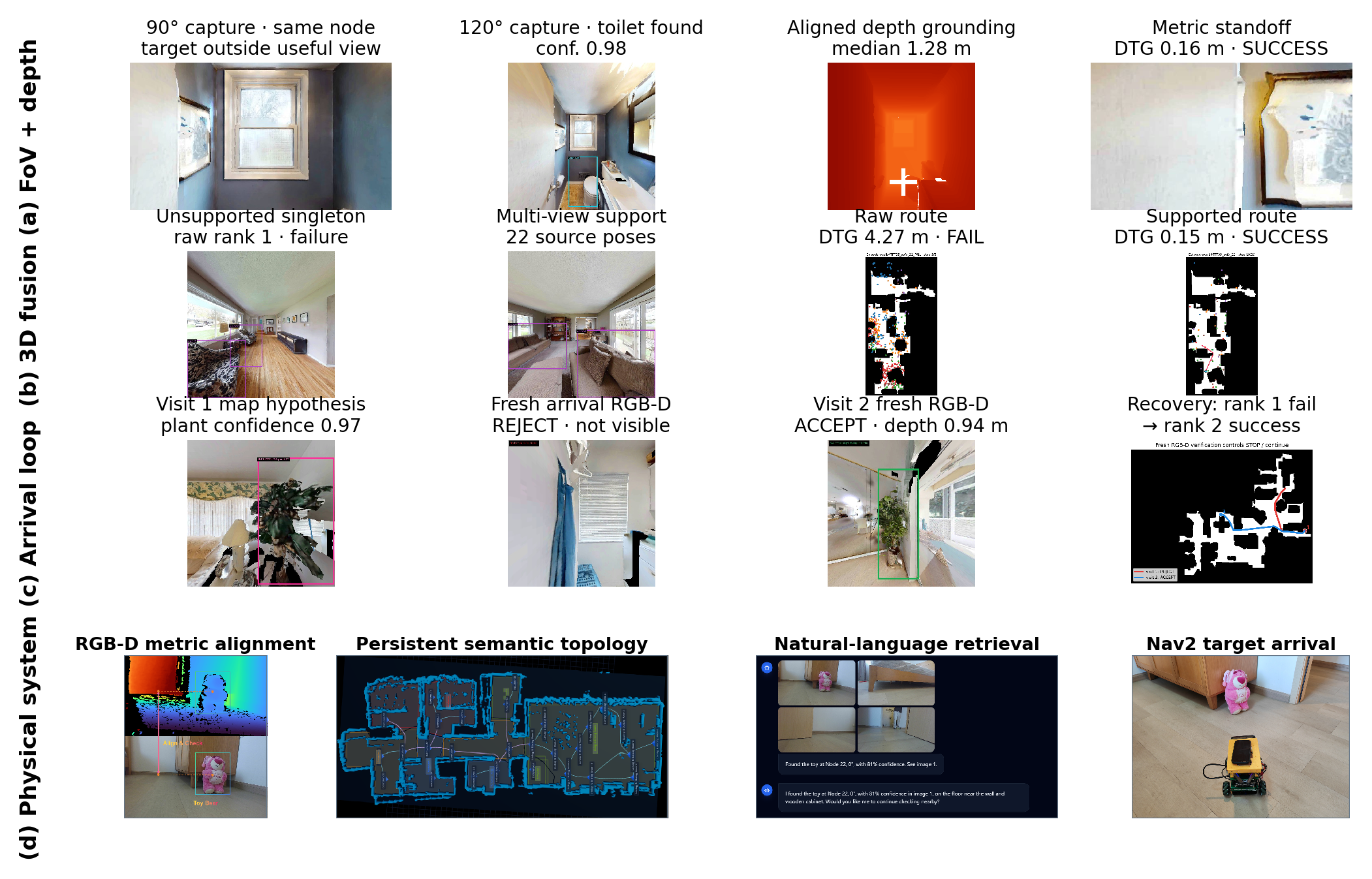
Audited SSTG-Nav cases for field of view and depth, 3D fusion, arrival recovery, and physical-system operation
Audited cases. Representative evidence spans sensing, 3D fusion, recovery, and the physical system.

Open benchmark

Reproduce the reusable ObjectNav evaluation.

The public SSTG-Nav implementation covers topology construction, calibrated RGB-D grounding, source-aware fusion, retrieval, sequential recovery, evaluation metrics, and validation utilities for Habitat and HM3D.

Habitat / HM3DRGB-D grounding3D fusionTop-3 recoverySR · SPL · DTG

The complete robot-deployment and project-specific integration stack is not publicly released due to confidentiality obligations associated with the Huawei collaboration.

Public repository

DaojiePENG/
sstg-nav-bench

git clone https://github.com/
DaojiePENG/sstg-nav-bench.git
Explore the code

Citation

Found SSTG-Nav useful?

Please cite the paper and link to the public benchmark.

BibTeX
@misc{peng2027sstgnav,
  title  = {SSTG-Nav: Metric-Grounded Spatial-Semantic
            Topological Graphs for Reusable Object Navigation},
  author = {Peng, Daojie and Wang, Bingtao and Ma, Jun},
  year   = {2027},
  note   = {Preprint},
  url    = {https://daojiepeng.github.io/SSTG-Nav}
}